Great Plains Metals Corp – Everlsey Project Update
Vancouver, BC, Canada – Wednesday, November 12, 2025 - Great Plains Metals Corp. ("GPS" or "the Company", TSX-V: GPS, Frankfurt Exchange: 8VC) is pleased to announce that it has invested a further A$250,000 in Eversley Resources to increase its equity stake to 37.1%. The funding will be utilized in further developing the North Gawler Project in South Australia.
Highlights:
- GPS increases its stake from 24.4% to 37.1% in Eversley Resources
- GPS can increase its stake further by investing A$750,000 upon approval of drilling permits
- Upcoming work program planned to advance towards drilling known targets
- Multiple geophysical IOCG targets at shallow depth – potential district scale
The Company has the option to further increase its stake upon the grant of drilling permits by making an investment of A$750,000 to fund the drill program. The valuation of this subsequent investment is to be determined at the higher of either the current valuation (that this A$250,000 investment was made at) or an independent valuation to be governed by the VALMIN Code.
North Gawler Project (South Australia)
The North Gawler Project (Figure 1) is a large district scale tenement package that covers 2,584 square kilometres (granted and under application) with early-stage Iron Oxide Copper Gold (IOCG) and ionic clay type rare earth elements (REE) exploration opportunities. It is located in the under-explored region of the northern Gawler Craton with major discovery potential. It is 150km NNE of Prominent Hill. Rio Tinto interpreted the basement geology and confirmed district scale IOCG potential. Numerous IOCG targets were identified by Rio Tinto in an area of shallow cover during the early 2000’s but only limited follow-up exploration was completed.
The Jupiter target is ~7km long ovoid felsic pluton with surrounding iron-altered magnetic lithologies, including remnant magnetism (figure 2). The depth to the basement is estimated at 75 to 150 metres. In 1984, BHP drill holes intersected basement schists around 100 metres depth with magnetite±chalcopyrite mineralisation.
The Ganymede target is an ~15x1km, NW-trending magnetic anomalous zone adjacent to Keswick Fault with interpreted Fe metasomatism. The depth to basement is estimated at 50 to 150 metres. It is very rare to identify shallow IOCG targets in South Australia.
In addition to the IOCG district scale potential, there is an Ionic Clay REE prospect at Victory. Ground spectrometer surveying and regolith grab sampling by Reedy Lagoon Corp Ltd in 2010 identified anomalous Cu-Co-U as well anomalous REE’s. Sample descriptions indicate that the highest grade REE samples are associated with kaolinized saprolite at shallow depth below surface (0.1 to 0.5 metres) and indicate the potential for ionic clay type REE mineralization. Proof of concept to establish ionic clay type REE potential can be done inexpensively using grid based hand auger sampling and metallurgical test work.
Exploration Work Program
The upcoming work program includes GIS data acquisition, spectral analysis for alteration signatures; refinement of geophysical models and drill planning for priority IOCG targets.
In addition to the work program at North Gawler Project, further work will be done to advance the granting of the tenement at the Ashburton Project in Western Australia including data compilation – magnetics, gravity and GIS data for modelling and targeting with a view to plan a reconnaissance field exploration program.
Aidan Bishop, CEO, commented:
“GPS is pleased to increase its stake in Eversley Resources and we plan to advance our position further as the project reaches certain milestones. The geophysical anomalies have identified clear areas of interest. The upcoming work program will seek to further refine known drill targets where district scale IOCG potential exists at shallow depths below cover.”
Qualified Person: The scientific and technical data contained in this news release, has been reviewed and approved by Douglas J. Kirwin, who serves as the qualified person (QP) under the definition of National Instrument 43-101.
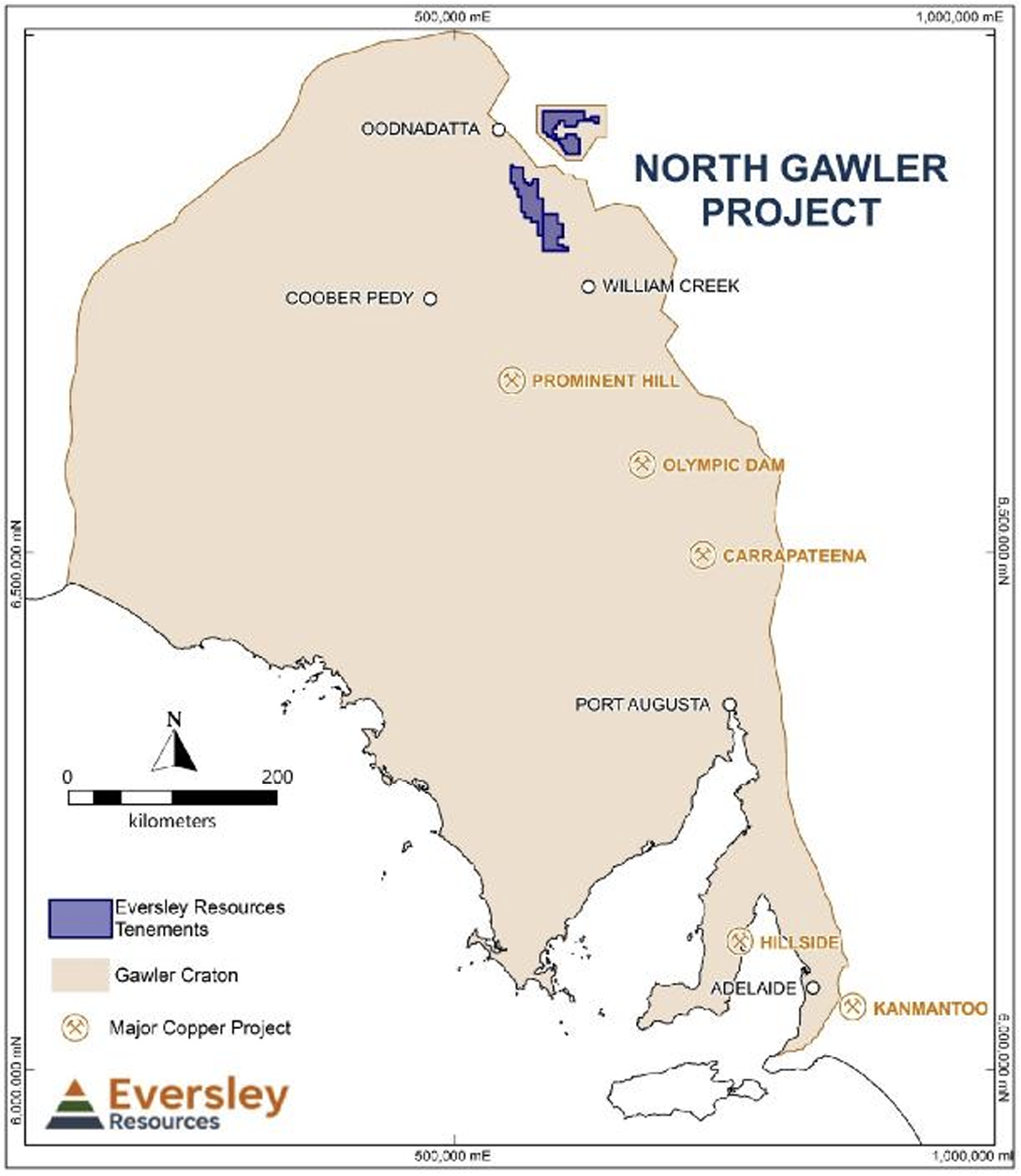
Figure 1. Map showing location of Eversley’s North Gawler Project exploration tenements in South Australia.
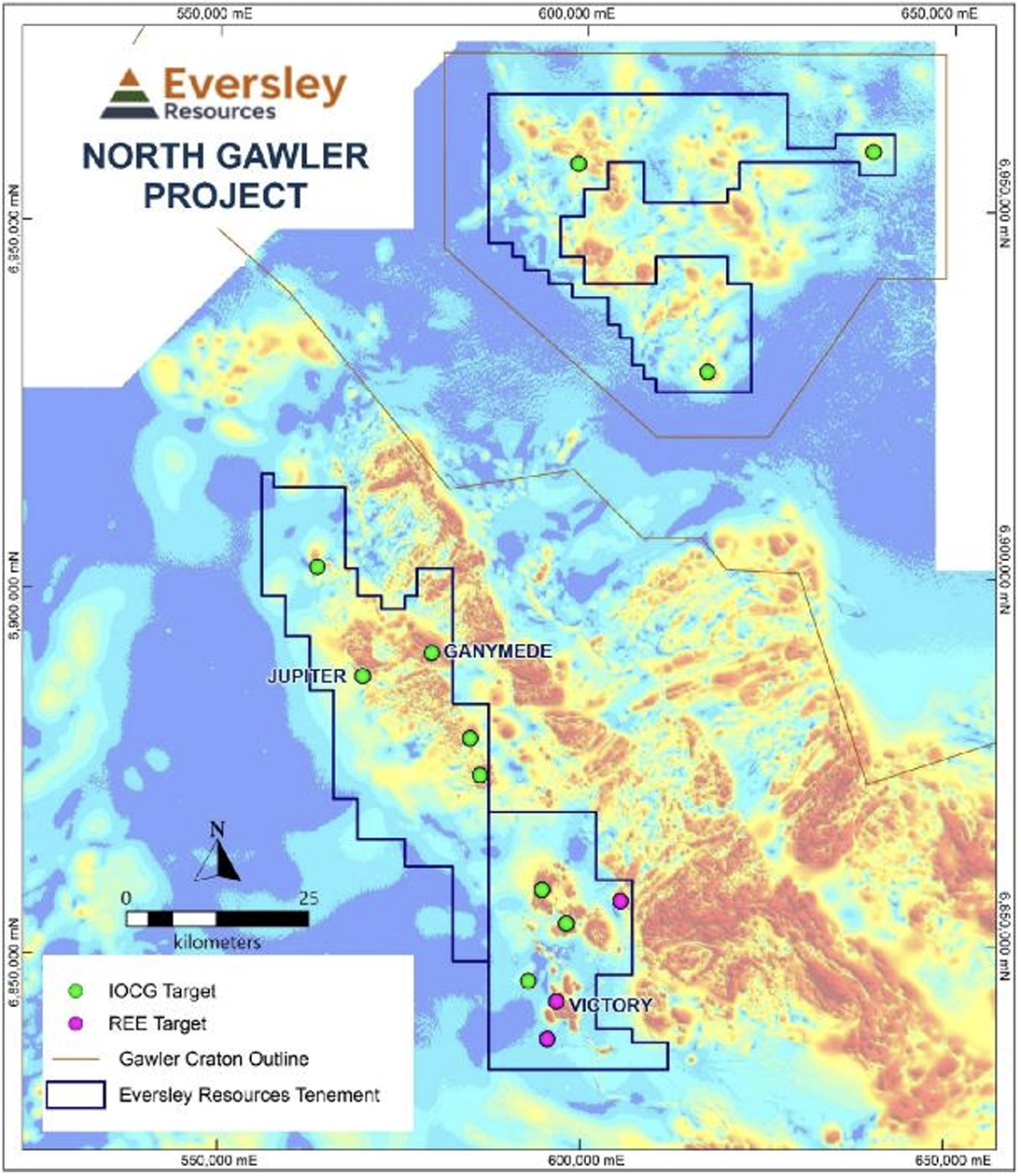
Figure 2. Eversley’s North Gawler Project exploration targets with reduced-to-pole (RTP) magnetics image.